

Daddy issues
Men, the call is coming from inside the house...
Last night, I watched Louis Theroux’s Netflix documentary Inside the Manosphere, and there’s just so much to say.
I’ve been a big fan of Louis for years. I watched Weird Weekends as a child in the 90s, and the DVD box set sat proudly on my bedroom shelf.
Louis has continued to explore the weird side of life, while also foraying into the more dangerous (the Johannesburg apartment block, IYKYK). This new piece is obviously part of Louis’s ongoing attempts to stay relevant, and I think he does manage to bridge the gap between his generation and Gen Z.
This week, but I wanted to dig into one ongoing theme in Inside the Manosphere… and the call is coming from inside the house.
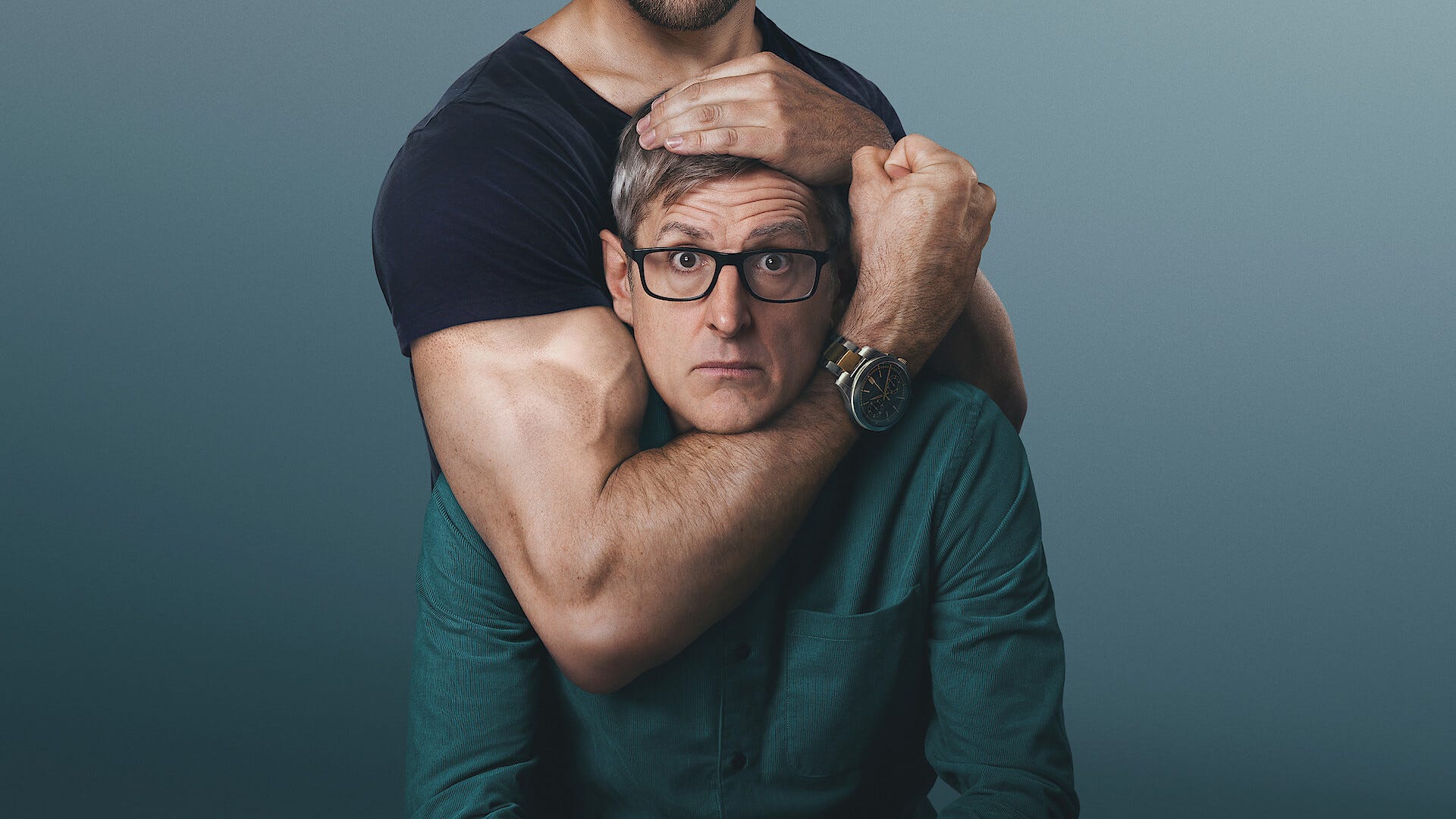
Inside the Manosphere
Louis follows problematic influencer HSTikkyTokky (24) - real name Harrison Sullivan - who uses controversial, short-form content to grow his financial empire, the intricacies of which aren't really explained, but I assume it's some sort of pyramid scheme.
Harrison is Louis’s perfect interviewee, as he digs himself into holes time and time again. Louis mostly stands back and watches this lad make a fool of himself.
There is a particularly excellent moment where we see a clip from Harrison’s own stream in which his mother is trying to get him to hydrate, and he says, “I don’t want a juice, mummy.”
It might be my age, but Harrison is never a particularly sinister figure (unlike others featured in the show). To me, he’s a child. A pretty stupid one at that.
We get to know Harrison throughout the course of the episode, and it’s revealed that his father has been mostly absent for most of his life. And also that his mother doesn’t share any of his views on women or homosexuality.
There is an immediate contradiction here.
Harrison is a mixed-race kid, raised by a white single mother in Essex. It’s worth mentioning he didn’t grow up ‘hard up’, he went to private school and was likely handed everything (bar paternal love) on a plate.
On paper, he wouldn’t agree with his own mother’s status as a single mother… a premise on which his entire life relied.
So, what’s going on?
Harrison’s dad is actually retired England rugby star Victor Ubogu. So, not only was the kid raised without a father, but he also knew that this bloke was widely respected and played sport at a national level.
How humiliating.
I’ll go out on a limb here and say this is where it all began for Harrison.
Women are not, and will never be, the problem for these men.
The problem is other men.
Patriarchy affects everybody. Even those who perpetuate its rhetoric.
The only way to solve issues like the manosphere and its mass conversion of school-age boys (we’ve all seen Adolescence) is for there to be better male role models. It’s really got nothing to do with women (and yet we suffer the most).
According to the National Literacy Trust, parents are still the most important role models in a child’s life. Where parents are letting kids down, influencers are stepping in.
In her PhD study, Amanda Dylina Morse worked with 30 boys in Belfast between the ages of 16 and 19. She found that most of them had neutral or positive opinions of manosphere leader Andrew Tate, but that community role models could have an even greater impact on these kids’ lives.
Even the kids in Amanda’s study seem to differentiate between the more extreme, controversial views of Tate and his crew with his more digestible rhetoric about prioritising health and fitness.
It turns out my theory about men being responsible for their own demise is not new. Act Mental Health found that 40% of men in a survey of 1,000 had never spoken to anyone about their mental health – despite the fact that 77% of these men have experienced symptoms of depression, anxiety, and stress.
This study from the American Journal of Men’s Health went a step further:
Traditional masculine norms among men have been reported to make them more susceptible to mental health issues
Huh.
So the traditional patriarchal structures being touted by Harrison and other interviewees in the documentary are actually causing their problems.
It takes a village
We all know the saying “it takes a village to raise a child,” and the importance of IRL communities extends far beyond boyhood. The distinct lack of male-oriented spaces in the real world directly impacts mental health on an individual level. If every interaction you’re having is online and therefore for clout, then it’s not authentic.
Online communities like those run by Harrison are built within the attention economy, with heavy focus on clip farming for short-form video platforms like TikTok.
This is not the same as a little Discord server about your favourite band… it’s about continually competing with other influencers to gain more traction and, therefore, earn more money. Manosphere influencers are essentially monetising their social interactions… the more extreme, the better.
Not only does this create a strange parasocial relationship between influencer and viewer (we see this in the doc as one of Harrison’s fans became a member of his team after interacting with the team online), but it also encourages boys and young men to strive for hyperindividualism… which is the stark opposite to being part of a community.
PhD Candidate in Human Geography at Newcastle University, Sophie Lively wrote about exactly this for The Conversation in her article entitled “Hyper‑individualistic and focused on worth, the manosphere is a product of neoliberalism”
The manosphere picks up on messages around failing. Alongside hate-filled and misogynistic content, shame-based narratives from the manosphere suggest that boys and men are losers, weak and lazy if they aren’t “succeeding”. This is deeply damaging to all who find themselves drawn to such messages.
The concept of self-worth regularly appears in the manosphere, but it’s largely in relation to wealth or productivity: hustle harder, rise and grind, make money. These ideas don’t just exist in these online spaces. Similar language – self-investment, output, productivity, personal growth, efficiency – has become part of our everyday way of talking about ourselves and others.
We’ve come to the part where the dog is chasing its tail, and while men like HSTikkyTokky might be profiting now, there’s no doubt that they are the losers in the long run.
In an attention economy, you can’t stay relevant forever.
What does stick around forever is the way you’ve wired your brain to fail… and only through the support of in-person communities where men show vulnerability and grow beyond these attitudes.
And that is what will make all the difference for future generations.

Listen to episode 2 of the podcast!
Nicola Muthurangu-Hall of The Exposition are back this week talking about zombies. You can listen on Spotify and follow us on Substack: Emotionally Invested Podcast .
I had a great weekend up in Edinburgh visiting Michelle | Specky Scribbler and seeing CMAT live at the Corn Exchange. Here are some other things I’ve been enjoying:
📚 She Wanted More by Poorna Bell - This couldn’t have come at a better time in my life. I listened to the audiobook but I’ll be getting a physical copy to annotate for sure!
📽️ The Worst Person in the World (Channel 4) - Joachim Trier’s film before Sentimental Value is about a woman who continuously makes questionable choices in her life in an attempt to find happiness. Again, very relevant to me right now.
See you next week!
Ellen x
💌 About this email
I’m Ellen, and I write about mental health for the chronically online. I am a freelance copywriter, strategist and web designer, and I work from home at Content By The Sea. We have two rescue greyhounds, Potter and Harmony, and a toddler.
💛 How you can support me
If you like reading my weekly emails, you can give me a kickback in one or more of the following ways:
📨 Share this post
📬 Subscribe for free (if you haven’t already!)
💬 Leave a comment on this newsletter
Thanks for your piece. I am aware that you are writing about Mental Health, and my own early research relates to Domestic Violence. There was a pivotal, unexplored moment in the documentary that cracked the facade: the relationship between HSTICKYTOCKY and his mother.
The bond between boys and their mothers is often cited as the crux of the 'Manosphere' phenomenon. When a boy feels powerless or resentful toward his mother, that repressed anger can later be projected onto women in general. Take Andrew Tate, for example—he frequently blames his mother for moving him from the US to the UK, separating him from his father. I know this might be unpopular because it sounds like I am 'blaming women' again, but it’s a psychological dynamic that deserves a deeper look.
I watched Manosphere the other day and instantly hoped you'd write about it. I feel exactly the same. Equal parts hopeful and terrified about raising girls amongst this. I tell myself they're just big children, but the influence they have is horrifying.